The artists I am going to put in my imaginary exhibition are Yayoi Kuasama, Grayson Perry, David Hockney, Jeff Koons, Wayne Thieabaud.
The web site for my imaginary exhibition can be found at this link https://640f1a822184e.site123.me/
https://640f1a822184e.site123.me/
here I am making a model of my imaginary exhibition.
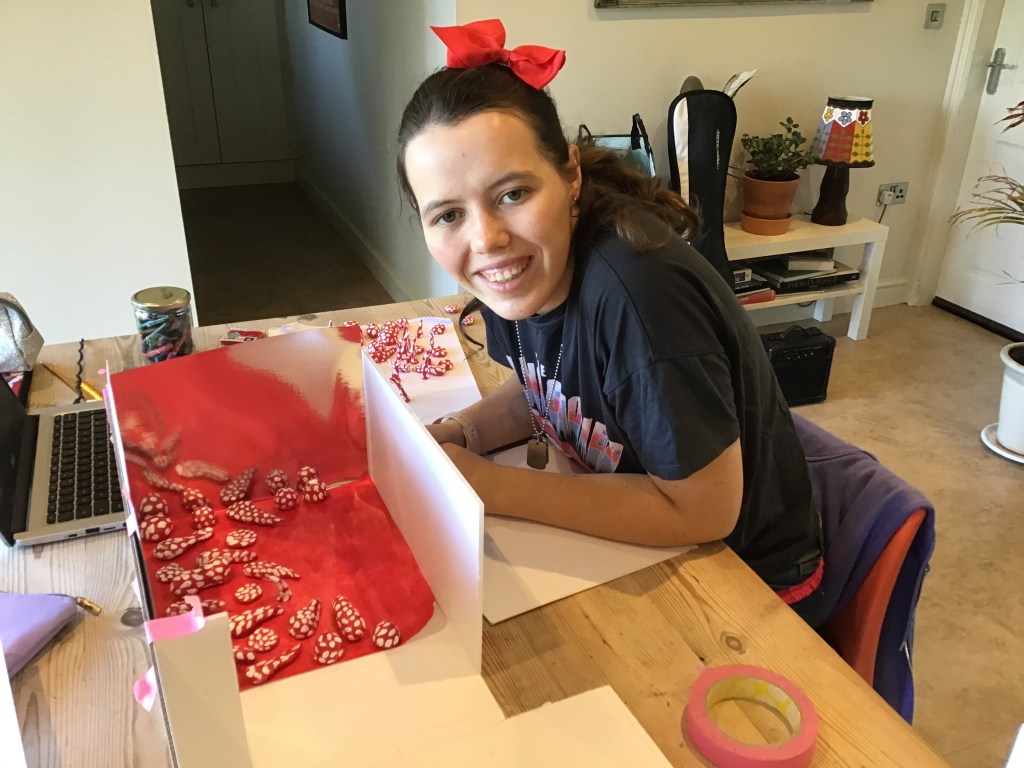
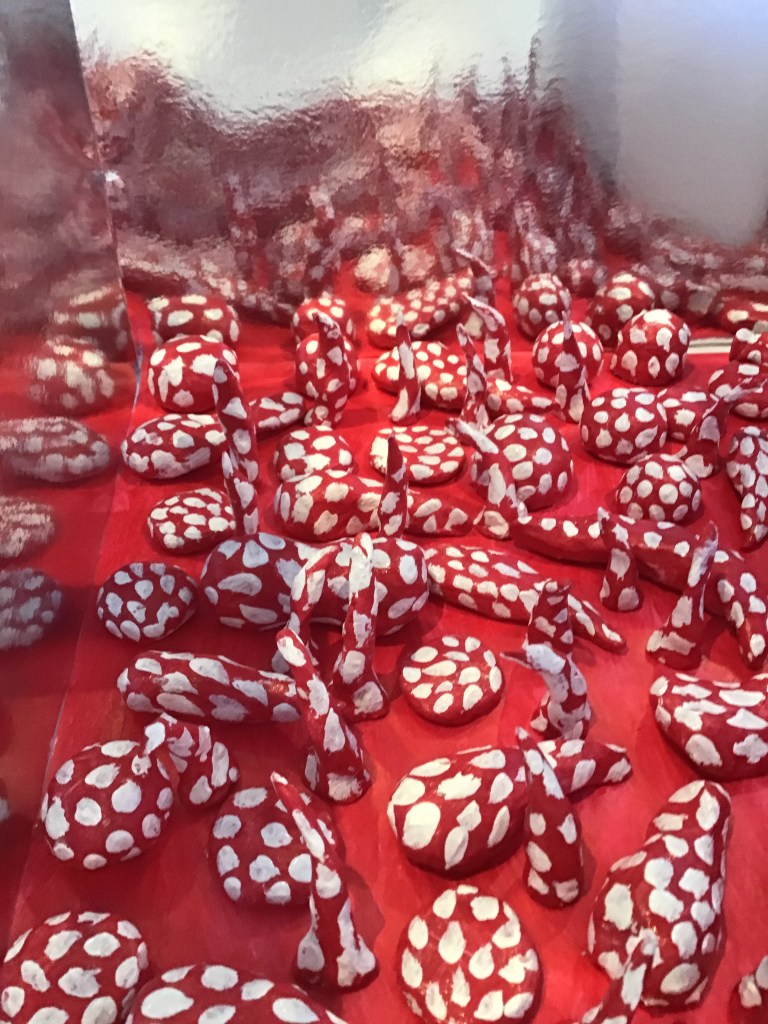
I used mirrored card to create Yayoi Kusama’s never ending reflection.
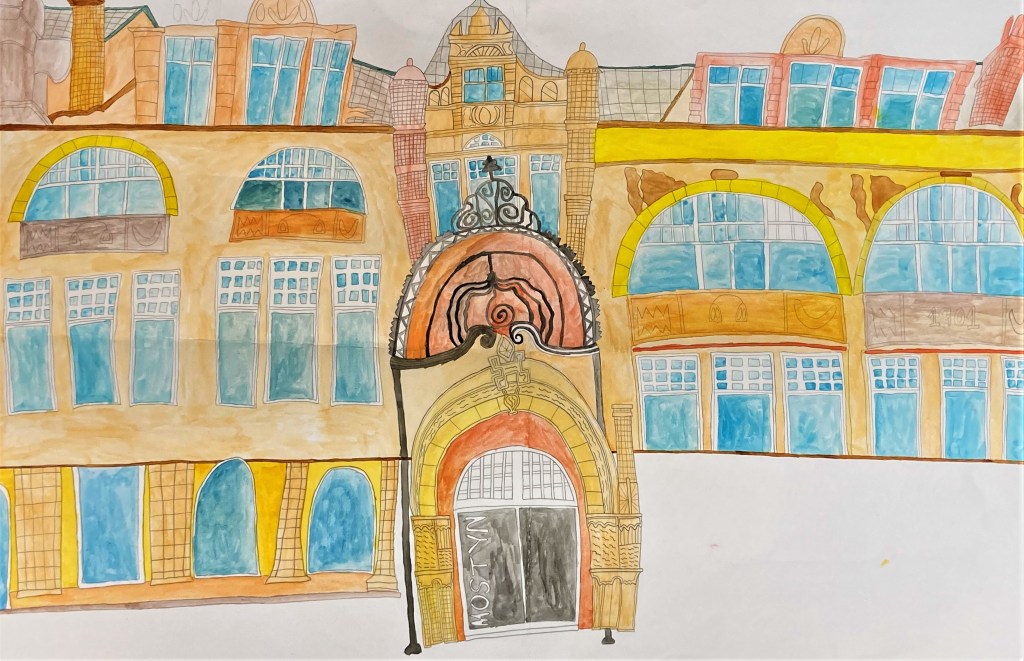
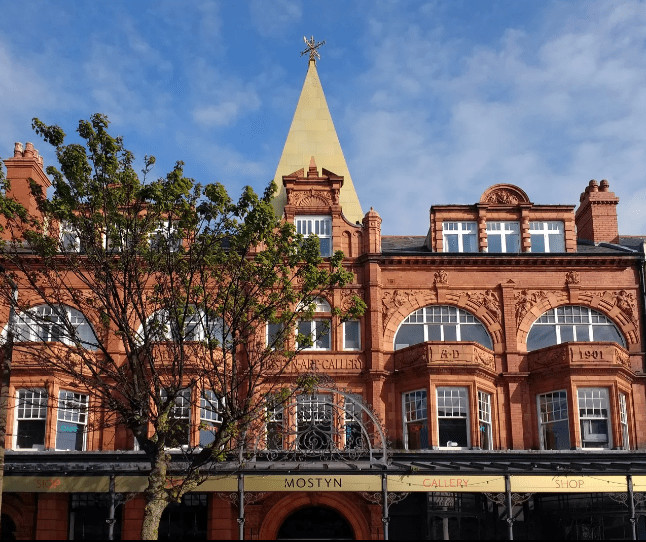
This is a painting I did of the front of the Mostyn Gallery to put on my model. I like details of the windows and and the different colour of the walls.
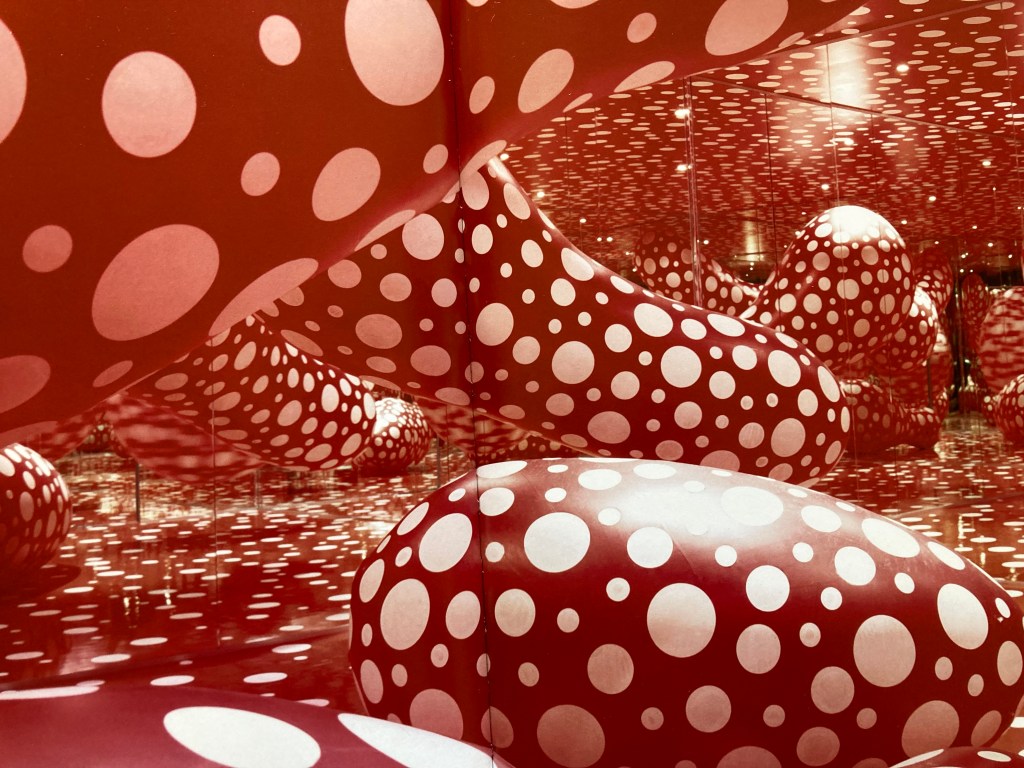
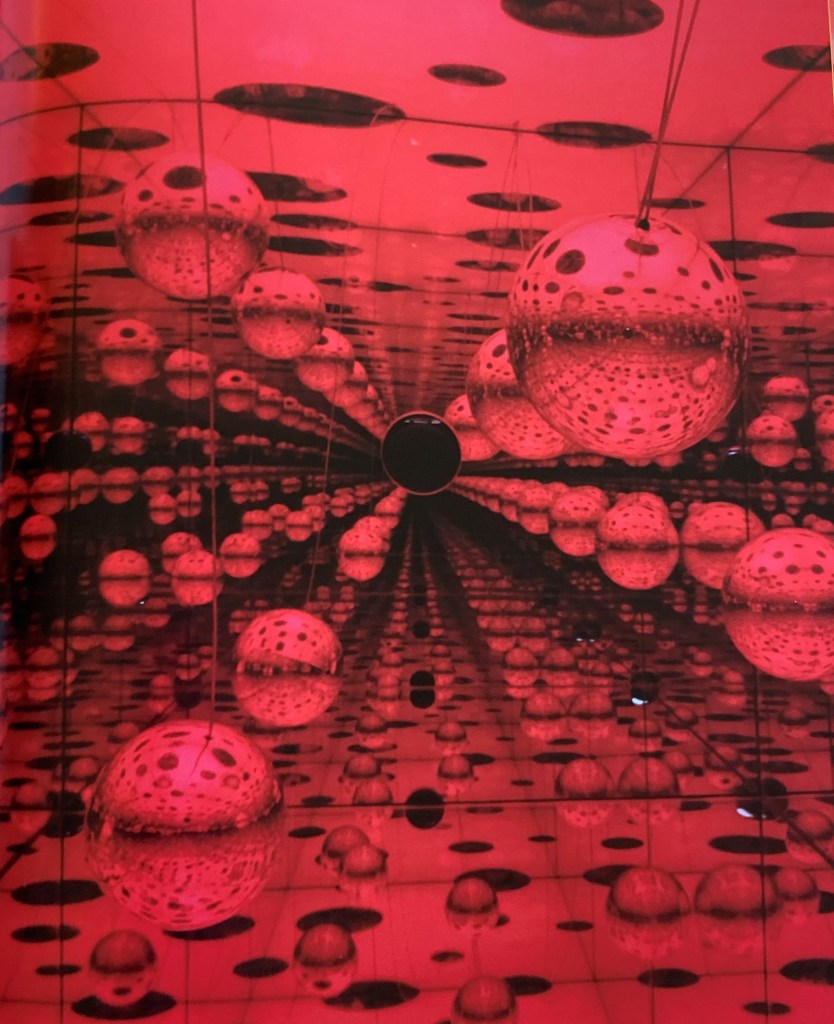
You think that there are more polka dots but then you realize that it is just mirrors. I would stretch my arms out to feel around me and not to bump into mirrors. It is like a maze but it is is fake, it is a dead end. When you walk through you have to be careful not to bump into things. The floor and the balloon like forms and the mirrors are the same because of the polka dots. The polka dots are everywhere, like camoflage – like hidning. I would be hiding in the room if I was covered in polka dots. Yayoi is hiding herself.

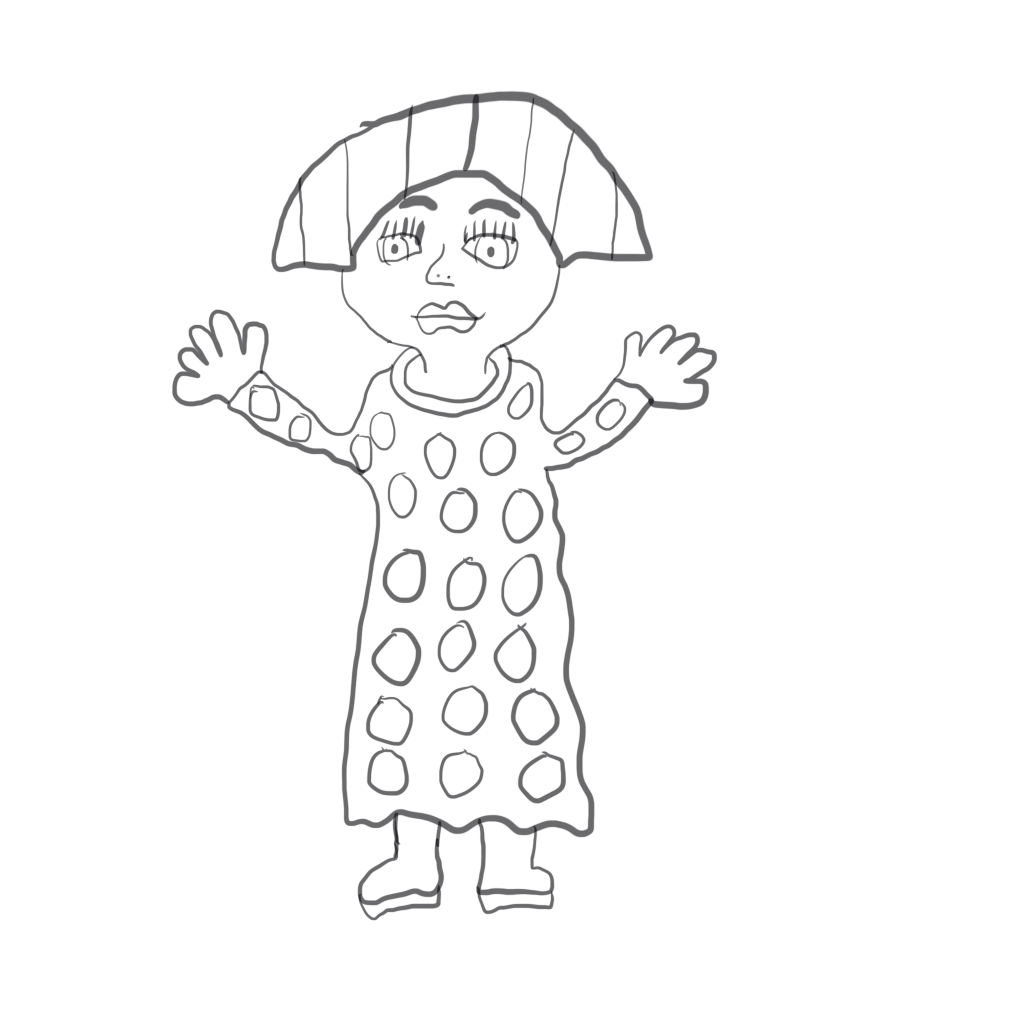
These are digital drawings I made of Yayoi on Heather’r ipad.
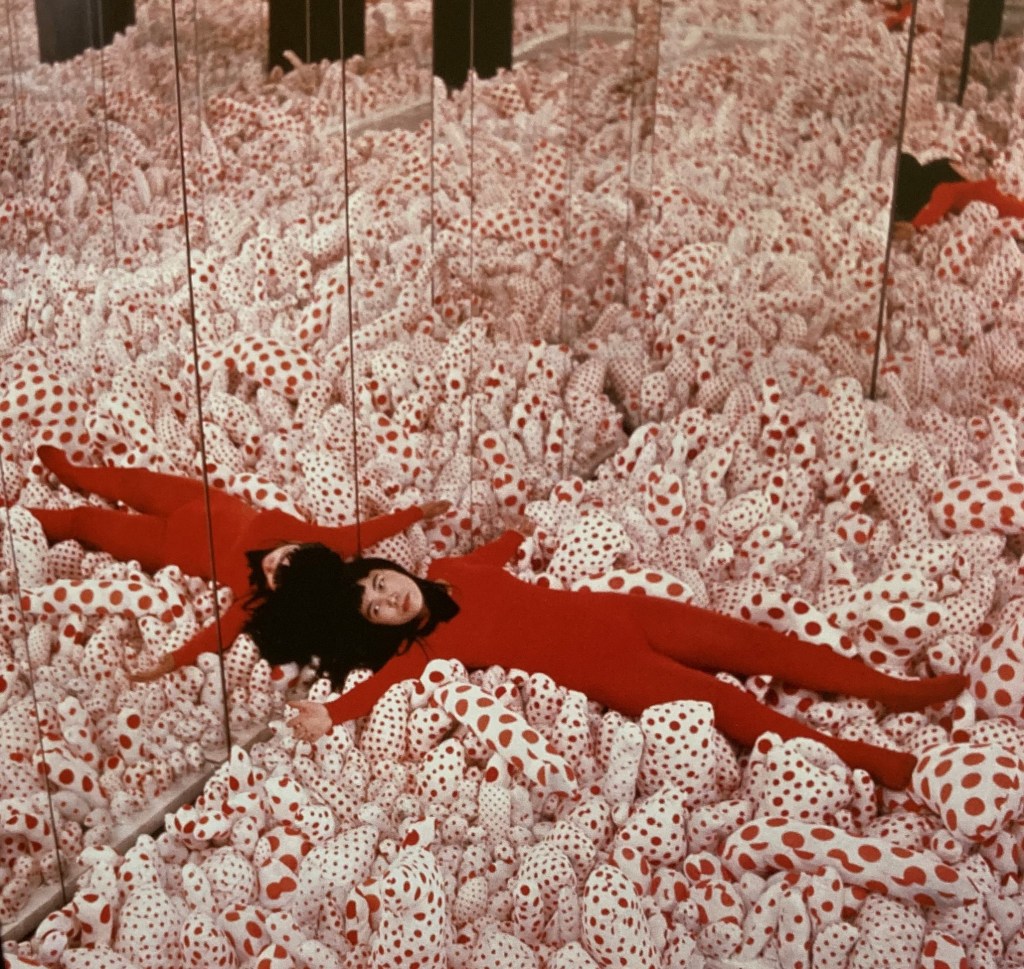
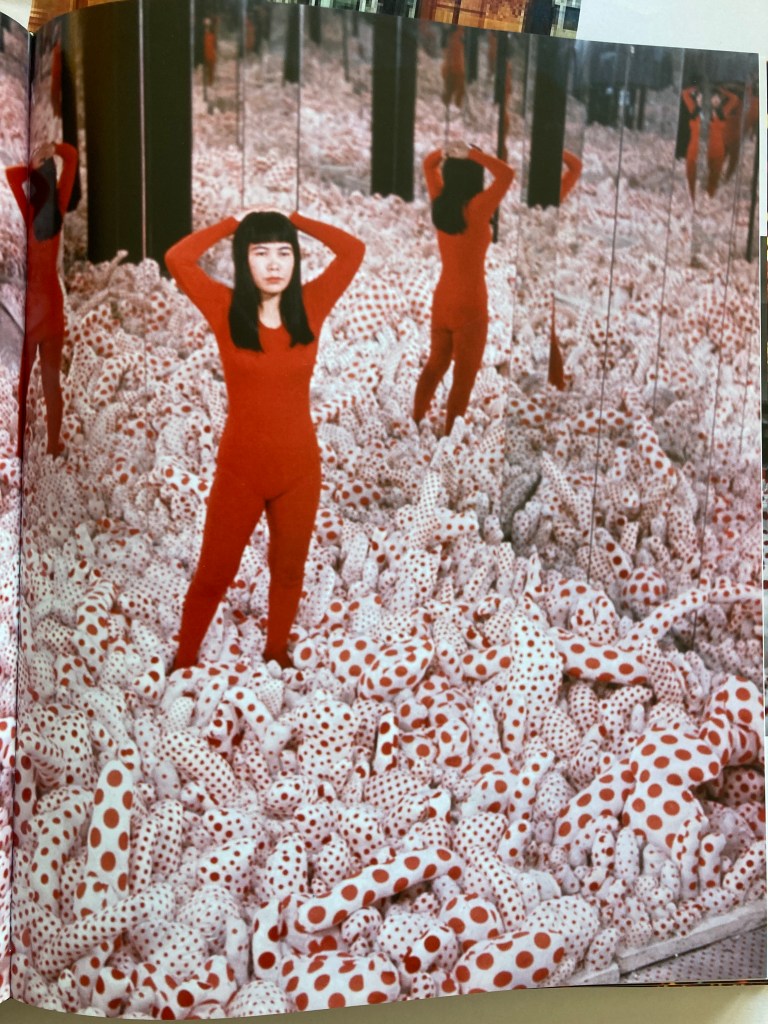
It is like a jigsaw or a collection of toy cushoins, they are soft and don’t hurt. It reminds me of the machines in fun fares or games room.
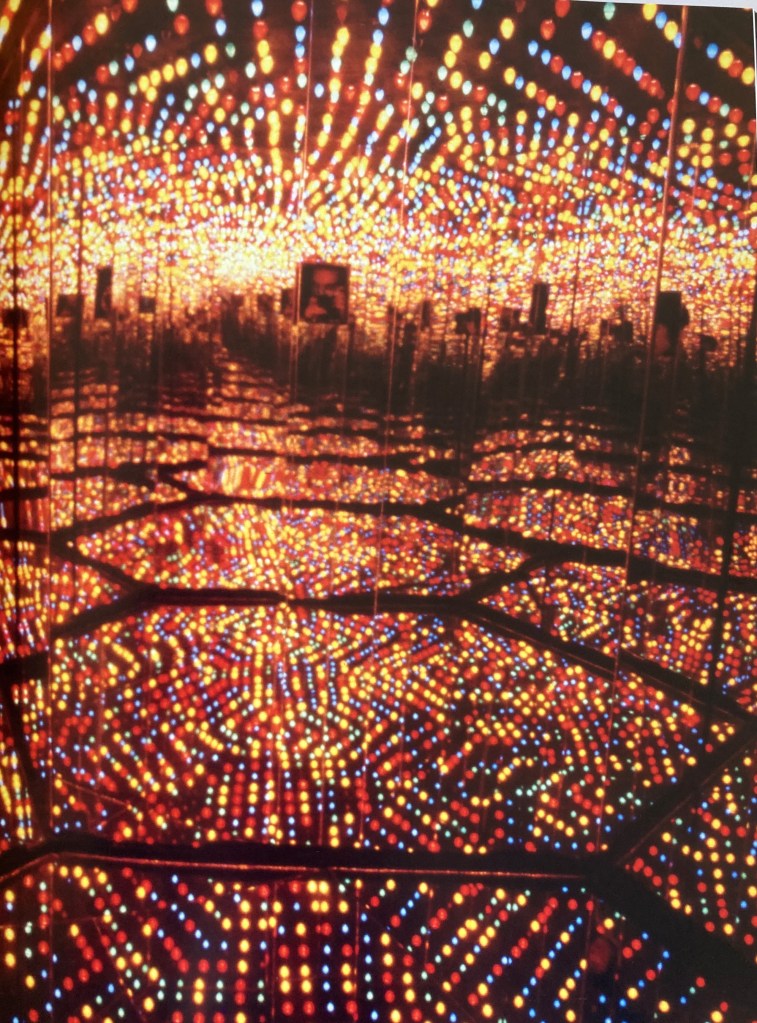
Kusama’s Endless Love 1966 Hexagonal mirrored room and electric lights. I like lights and makes me open my eyes reminding me of Christmas light and fairy lights. Makes me feel happy and life saving and keep me safe and happy for ever. The lights go on for a long way, to a dead end.
The Mostyn gallery in Llandudno has been chosen for its size and location in Llandudno to suit these works .The building is a cross between the old and modern and each of the artists’ works are contained within a minimalist white singular separate room. The artworks presented draw upon a broad and contrasting range of approaches to creating artwork; sculpture, painting, and installation. Kusama’s work is based on the patterns and repetition and inspired by her childhood whilst Jeff Koons’ work focuses on celebrations such as children’s parties and the cakes painted by Wayne Thiebaud suggest afternoon tea and birthday cakes, creating happy feelings.
Yayoi Kuasama
Kuasama is a Japanese artist that is especially known for doing polka dots. She was born in 1929. Her family owned a seed plant and nursery farm.
In 1963 she made a boat full of coral like shapes.
In 1986 Kuasam is pulling strings like a spiders web. The string cris-cross the space and she is stuck in the middle in a tangle.
In 1998 Kuasama is holding two pieces of paper saying “LOVE FOREVER”, I believe that she is doing this because she loves polka dots.
In 2000 there is a room like a kitchen with two lines dark and light, polka dots, looking like something in a disco parlour, they are like they are space like the stars. It is like my bedroom where I have covered the walls and ceiling with pictures of food, my imaginary characters, and relatives.
It is related to Kuasama’s hallucinations.
2001 is a mirror room with orange lights, water shining in front of it, it is not an entry to another one but a dead end. Like fire works creating a sense of wonder. Kuasama is wearing the same pattern as the walls and a ring on her finger that is similar.She is in camouflage, to hide into the background, to surprise people, coming out of her world. I wear a red ribbon in my hair.
2012 shows kuasama wearing a polka dot dress and a bright red wig and her eyes are wide and welcoming people into her world.
2016 Kusama is painting another plantation in front of a plantation background in black and white dress.
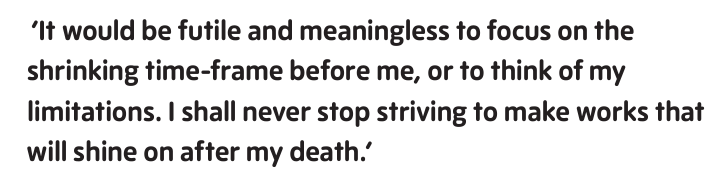
Once she passes away the legacy of her work will live on.
“Forget yourself. Become one with eternity. Become part of your environment.” Enjoy what you like the most.
Memories of Happiness and Comfort – Catalogue
In our lives events and things we encounter are capable of triggering powerful recollections or involuntary memories of the past.
Pictures are capable of promoting thoughts and triggering memories of past events, objects and sensations and a picture can trigger a previously forgotten moment much more quickly than words. People are able to encode pictures and store information containing specific visual qualities in the brain. Events that cannot easily be recalled can be remembered when shown a picture.
As an artist, I love to write stories about myself and my memories and what makes me happy. I love decorating boxes, plates and ice cream cups with childhood memories and made-up characters. I have produced large scale paintings of tea, cakes and comfort foods. My own style and themes have been instrumental in curating this exhibition.
The artists featured in the exhibition Memories of Happiness and Comfort are Yayoi Kusama, Jeff Koons and Wayne Thiebaud. These artists have been selected because their work is associated with memories, memories of happiness, celebratory moments and the comfort of familiarity. Within this exhibition there is a sense of wonder, comfort and illusion. The works convey a dreamlike nostalgic quality reminiscent of childhood trips to the fairground.
The selected artists have a range of themes running through their work, all unique to their practices but connected through concepts and ideas relating to celebration, delight, wonder and the experience of the beholder. The artists draw upon their relationships, connections and memories of family background and nostalgic surroundings. The exhibition consists of a small selection of works sited within the gallery, each of the artists’ works are contained within a singular separate room. The artworks presented draw upon a broad and contrasting range of approaches to creating artwork; sculpture, painting, and installation.
The artists featured in the exhibition Memories of Happiness and Comfort are Yayoi Kusama, Jeff Koons and Wayne Thiebaud. The work of these artists has been selected because of its association with memories, memories of happiness, celebratory moments and the comfort of familiarity. The works here have been chosen for their sense of wonder, comfort and illusion with many conveying a dreamlike, nostalgic quality reminiscent of childhood experiences.
All three artists have a range of themes running through their work which, although unique to their practices, are connected through concepts and ideas relating to celebration, delight, wonder and the experience of the beholder. The artists draw upon their relationships, connections and memories of family background and nostalgic surroundings.
My own practice as an artist is focussed on home life, my family and the food that we eat and share together and includes large scale paintings on white board showing detailed images of tea and cakes and food in an illustrative style.
Artists – Yayoi Kuasama
Kusama is a Japanese artist that is especially known for creating works with polka dots. She was born in 1929. When she was young she lived on a seed farm and plant nursery and as a child she began seeing dots everywhere. Her childhood can be seen reflected in the patterns in her work, much of which features polka dots. Kusama still exhibits internationally, although now in her nineties she has chosen a sheltered life within an institution, a hospital which provides her with comfort and safety.
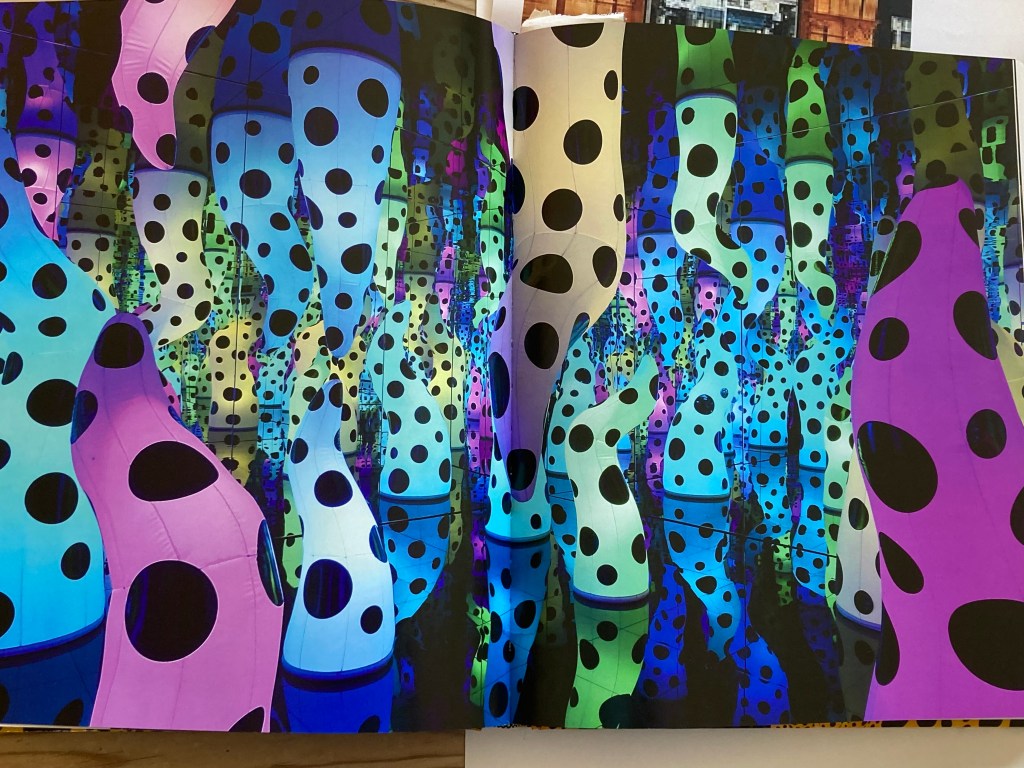
Kuasama’s work is also related to the hallucinations she has and the obsessions within her life. Her installations are an extension of herself and her world. The dots that often cover her own body and extend into the whole installation can be seen to be a reflection of her transcending her own physical limitations and being completely interconnected.
Kusama’s “Dot Obsession” gives the appearance of endless polka dots but then it becomes clear that this is an illusion which is created through the use of mirrors. This leads the viewer to experience a disorienting space that requires care when moving about, requiring outstretched arms to feel around and not to bump into mirrors. It is like being in a maze visually as the balloon-like forms and the mirrors all look the same because of the polka dots which are everywhere. Kusama’s covering herself in polka dots is like a camouflage, almost hiding herself to merge into the background. Perhaps here she transcends physical boundaries and comes to share her world of hallucinations with the viewer.
“Forget yourself. Become one with eternity. Become part of your environment. Enjoy what you like the most” (Kusama 2017)
likehttps://www.huffingtonpost.co.uk/entry/yayoi-kusama-dots-obsession-norway_n_3306139 the most.”
Dots Obsession (1997)
At the entrance to her Infinity rooms exhibition at the Tate Modern Kusama states
“It would be futile and meaningless to focus on the shrinking time-frame before me’ or to think of my limitations. I shall never stop striving to make works that will shine on after my death.” (Kusama 2021)
“Whoever fights monsters should see to it that in the process he does not become a monster,” Kasuma says. “And if you gaze long enough into an abyss, the abyss will gaze back into you.” (Kusama 2021)
Pumpkin (1983)
Pumpkins were a recurring theme for Kusama. She used to sketch them when she was young on her family’s plant nursery that farmed kabocha squash and they symbolise her childhood. Kusama’s pumpkins are often cast in stainless steel and she sees them as warm and humorous with a human feel.
Kusama had been diagnosed with an obsessional neurosis, but she used her art to “self-obliterate” hallucinatory visions by compulsively reproducing the dots in her work.
“One day, she was gazing at a pattern of red flowers on the plastered with the same red floral pattern. I saw the entire room, my entire body and the entire universe covered with red flowers, and in that instant, my soul was obliterated and I was restored, return to infinity, to eternal time and absolute space. This was not an illusion, but reality itself. I was shocked to see to the depths of my soul”.(Kusama)
Artists- WayneTheibaud
Thiebaud was an American painter and printmaker and was a commercial artist until the 1940s when he became influenced by the Abstract Expressionist and the Bay Area figurative movement.
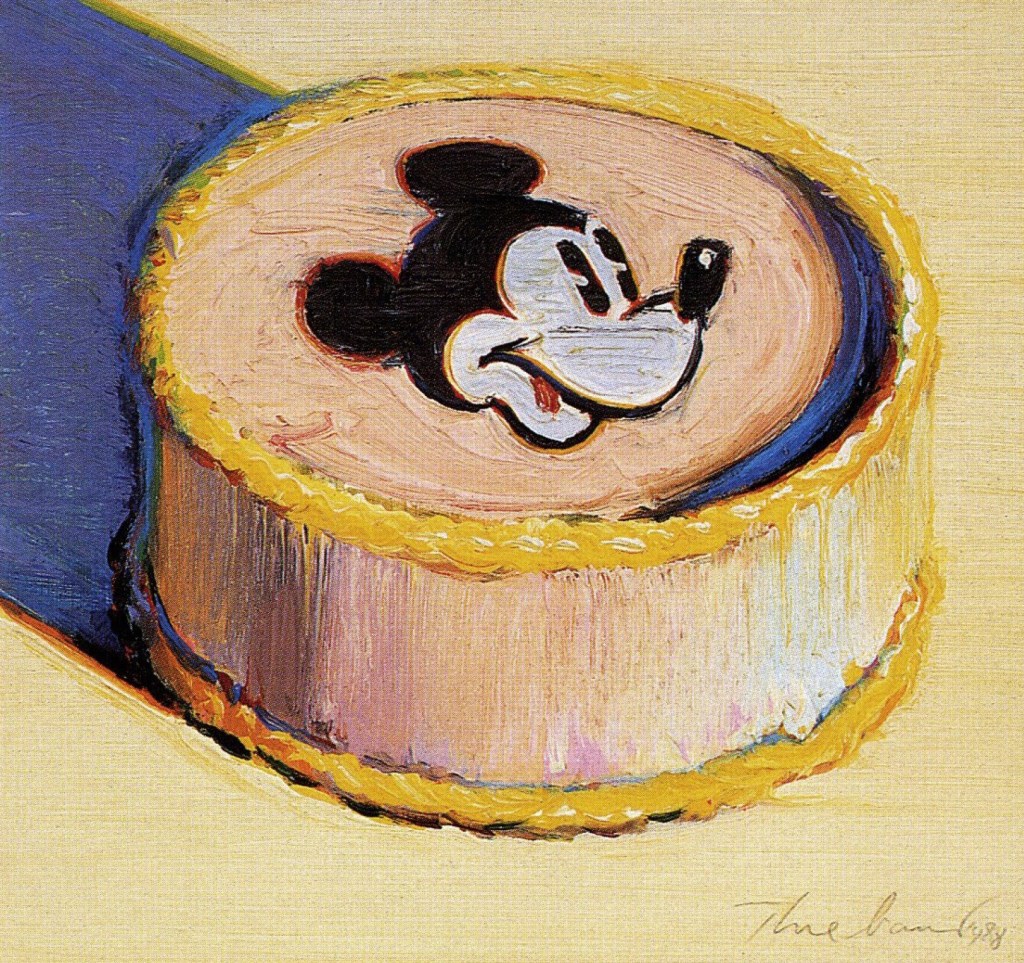
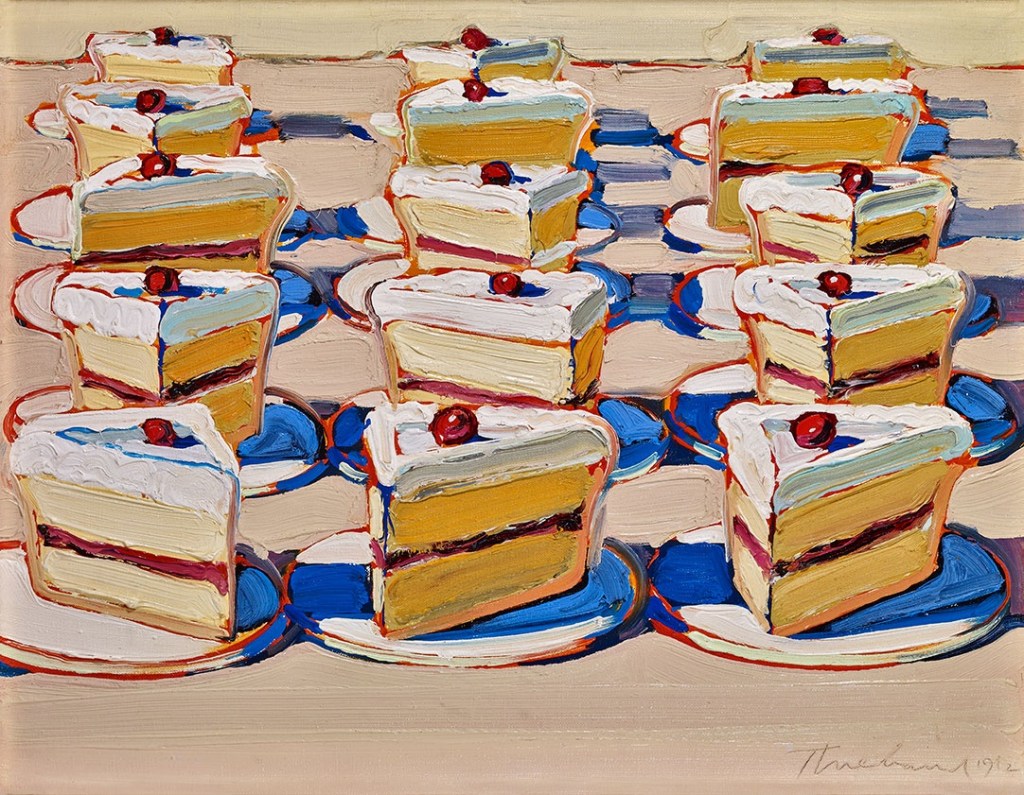
He was born in 1920 in Arizona and grew up in a Mormon family in California, living a long time until he died at 101 on December 25, 2021. He was known for his paintings of American everyday items such as food, shoes, cakes, as well as the streets of San Francisco. Thiebaud worked from life, his most popular work included colourful cakes, slices of pie and candy such as lollipops in which he captured a unique American sensibility. He uses heavy pigment and strong colours in his paintings, along with defined shadows.
Thiebaud belongs more to a classical tradition of painting than to the pop art world. His cake pictures with their use of repetition might seem similar to Warhol’s soup cans but his work is more warm, amusing and even nostalgic. As a painter, he experimented with brushstrokes, colour, light and shadow. The cakes reflect the work of 18th century still life paintings. By the 1950s, he started using thicker gestural brushstrokes, painting pinball machines, boys on the beach, bakery counters and cosmetics using bright colours. Later on, he turned to landscapes, playing around with unusual viewpoints and horizon lines of San Francisco city-scapes.
Thibaud began experimenting with shapes of triangles and squares and suddenly realised he had pictures of pies and cakes. Although he was considered a pop artist he found this conflicting as he felt more of a formalist capturing elements of Americana or everyday life.
Three Ice Cream Cones, (1964) The painting shows 3 ice cream cones each with a scoop of ice cream, chocolate, vanilla and strawberry, recalling dreams of childhood joy.
https://www.smithsonianmag.com/arts-culture/wayne-thiebaud-is-not-a-pop-artist-57060/
Bakery Case, with its half-empty tray of frosted doughnuts, pies and a festooned wedding cake, summons references to influential artists such as Bonnard and Matisse, as well as Josef Albers’ color theory that the perception of color is altered by the colors around it. When Thiebaud paints an object or form, he famously surrounds it with multiple colors, often stripes or lines, of equal intensity, to create a halo effect—though you might not notice that unless you look closely. “They’re fighting for position,” he says of the colors. “That’s what makes them vibrate when you put them next to each other.
Artists – Jeff Koons
Born in 1955 in York, Pennsylvania, he went to the School of the Art Institute of Chicago and the Maryland Institute College of Art in Baltimore and received a BFA in 1976. He started making small-scale assemblages of toys and ‘found items’ before moving on to create his famous balloon sculptures made out of highly polished stainless steel.
Gagosian.com/artists/Jeff-Koons/
Bouquet of Tulips (2019)
Koons’ work combines historical references with images of common everyday products found in mass media representing topics such as sexuality and transcendence. In his Banality series he has represented popular culture including sculptures of Michael Jackson & Bubbles. From 1994 to 2000, Koons produced his Celebration series of brightly coloured paintings and large scale sculptures, which combined readymade items with monumental works transforming everyday objects into abstract symbols of transcendence. He continued combining ready-mades with American pop culture with his large-scale inflatable figures.
Jeff Koons Banality series
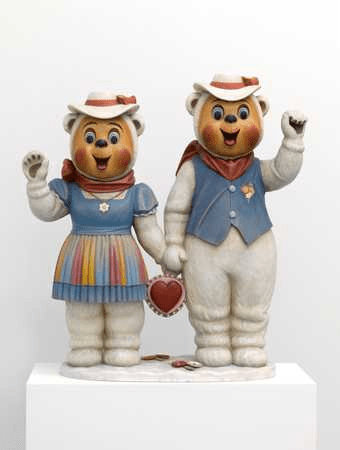
The Banality exhibition was largely made up of porcelain sculptures made by Italian and German workshops. This series from 1988, celebrates popular culture and the banal things that are unoriginal and boring. Koons used fine materials such as porcelain and crafts to create kitsch pieces like Winter Bears and Michael Jackson and Bubbles. Predicting that he would receive criticism from the artworld for these works, he placed adverts in art magazines mocking art loving readers and defending his position. These adverts contained images of himself in different roles that provoked people to question the type of art, usually seen in galleries. Michael Jackson and Bubbles is arguably the most famous piece of this series. Koons commented that “I was telling the bourgeois to embrace the thing that it likes, the things it responds to. For example, when you were a young child, and you went to your grandmother’s place, she had this little knickknack, that’s inside you, and that’s part of you. Embrace that.” ( Koons)
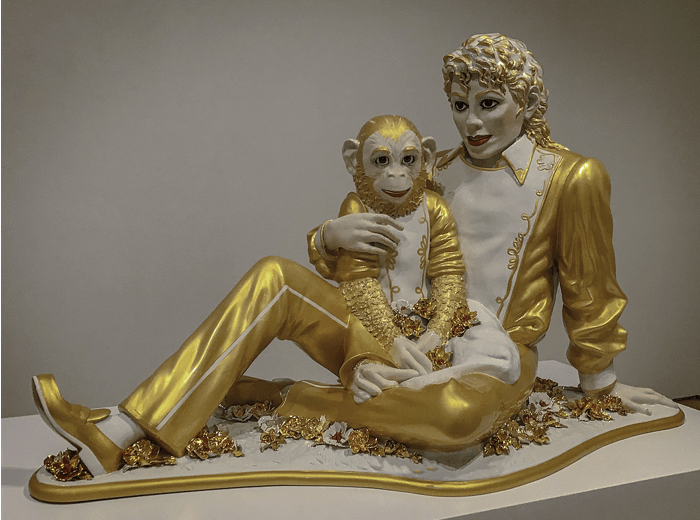
Michael Jackson and Bubbles
This is a larger-than-life-sized gilded sculpture made out of porcelain. It is based on a press photograph of the pair and is very close to the image. The sculpture shows Michael Jackson reclining on a flower bed together with his pet chimpanzee, Bubbles. They are wearing similar clothing in white and gold and appear as God-like, which could be seen to represent the culture of celebrity worship. Koons denies that there are any hidden meanings behind his work, although the piece could be seen as a religious portrayal similar to the catholic saints figurines often sculptured from gold leaf and porcelain. In this sculpture, Jackson is portrayed like a Greek God whilst in real life, he has actually become immortalised to his fans through his music.
It has been criticised for the way that Jackson is made to look white and feminine has been one of Jeff Koons’ more controversial pieces.
Koons used skilled craftsmen to create the Winter Bears sculptures with its highly polished surface. The sculpture is based on a child’s miniature ornament which could be seen to be a comforting object. Although it is over-sized and measures 1245 x 1170 x 450 mm challenging conventional pre compactions
This sculpture suggests love. The toy bears are holding hands and waving hello and between them they are carrying a heart bag. They are wearing hats and clothes. They are in love, “how romantic” the viewer might think and hearts are coming out of their head and smiling. Between the feet of the figurines are strawberries, red roses and iced buns. It is made out of pottery, something to treasure forever. In the art gallery they are saying hello and welcome to the exhibition.
Koons has an attachment to “ the artificial, the lovable and the cute” and he has always been fascinated with light and how it reflects on surfaces. his work is inspired by the idea of reflection, and the viewer is reflected on the shiny surface of the sculpture becoming part of the art.
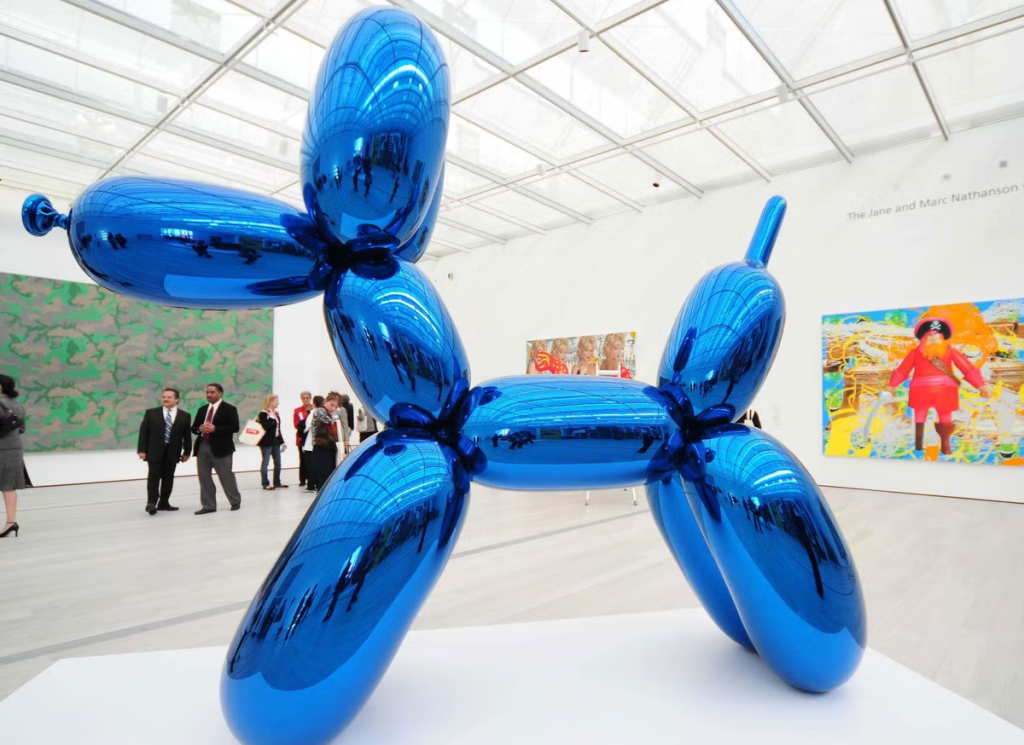
Each of Koons’ balloon dogs are made from precision engineered, mirror-polished, stainless steel and finished in either blue, magenta, orange, red, or yellow. They’re made to look like balloon sculptures made at children’s birthday parties.
Although Koons claims that there is no hidden meaning to his work, he does refer to the balloon and the act of inhaling and exhaling as symbolising the human condition. He says that it “Has this interior energy… it’s having a dialogue with interior life and exterior life.” (Jackson. K).
Dogs are known as man’s best friend and as a balloon animal, this has connections with our early memories of childhood fun and play. Both as individual and collective memories. These balloon animals can create emotional memories that link back to an early familiar magical period in our lives.
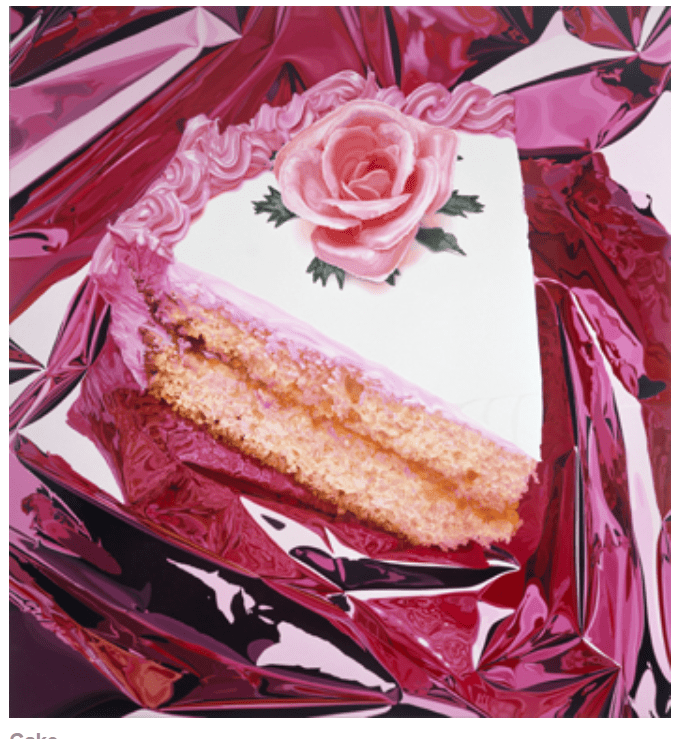
Cake 1995-1997
Cake is an oil-painting on canvas and part of TheCelebration series. The series includes paintings and sculptures that reference everyday life such as birthdays, and festive occasions and holidays. Cake is almost photo realistic and symbolises Koons’ interest in past experiences of childhood and reflects memories of an innocent happy early life. Each viewer will have their own personal memories of birthdays and cakes, and this will be reflected in each personal understanding and meaning taken from this image.
https://www.sothebys.com/en/auctions/ecatalogue/2005/contemporary-art-evening-n08092/lot.19.html
 Celf Seren Hâf Art